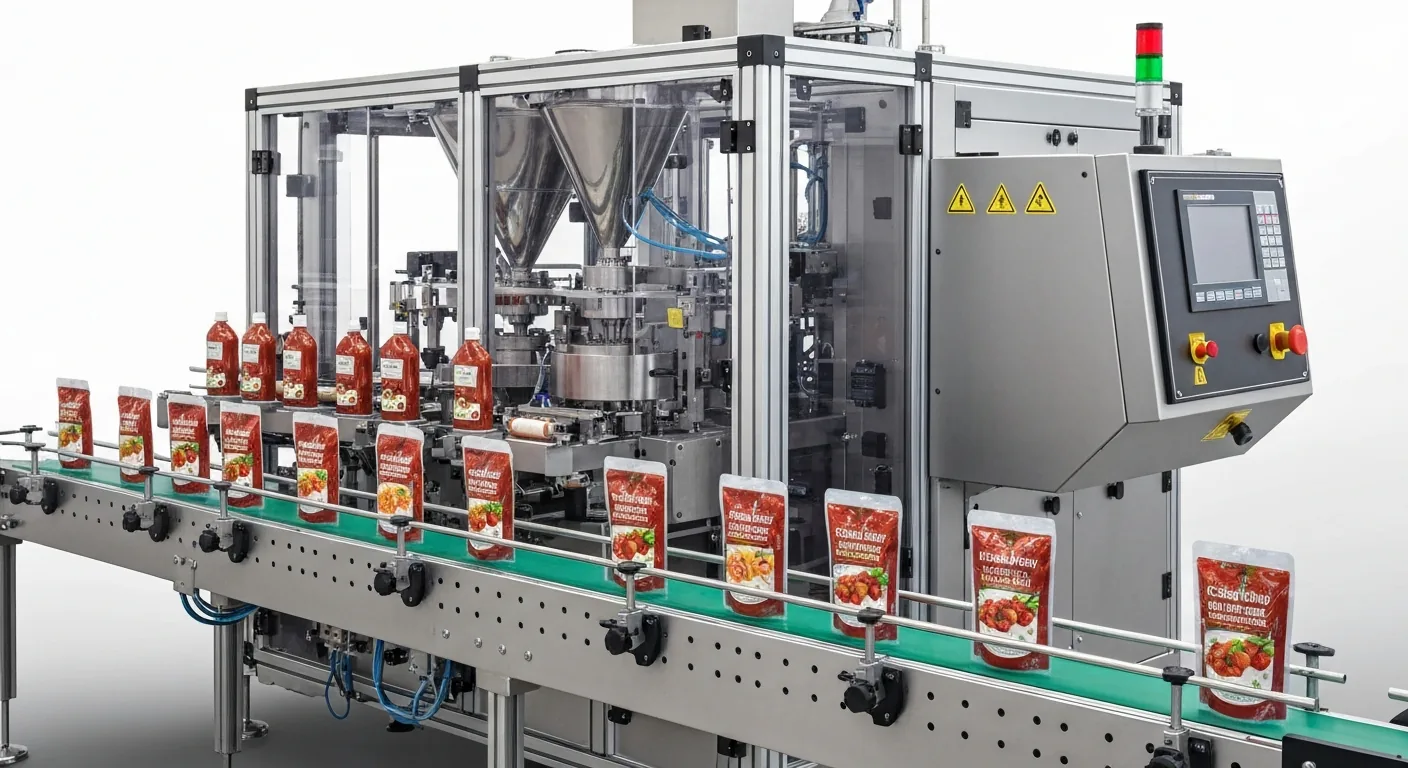
Form-Fill-Seal (FFS) technology is the dominant packaging solution for liquid and semi-liquid food products. From tomato paste and olive oil to salad dressings, marinades, and cooking sauces, FFS machines combine pouch forming, product filling, and hermetic sealing in a single continuous process — delivering high output rates with minimal manual intervention.
However, not all liquid foods are alike. The viscosity, fat content, temperature at fill, and required shelf life of a product each influence which FFS configuration, film type, and filling system will deliver the best results. This guide breaks down the key decisions for sauce, oil, and liquid food producers.
How FFS Works for Liquid Products
In a vertical FFS (VFFS) system — the most common format for liquid foods — a flat roll of flexible film is pulled over a forming tube, sealed along the vertical back seam, and then bottom-sealed to create a pouch. The product is dosed into the open top of the pouch by a filling system (flowmeter, piston, or peristaltic pump), and the top seal closes the pack. The process runs continuously at speeds of 30–120 pouches per minute depending on pouch size and product characteristics.
Horizontal FFS (HFFS) is also used for liquid foods, particularly in thermoform-based formats where a rigid or semi-rigid bottom web is formed, filled, and sealed with a flexible lid film. This format is common for single-serve sauce portions, dipping cups, and dairy-based liquid products (yogurt drinks, liquid cream).
Film Types for Liquid Food FFS Packaging
Film selection for liquid foods must address barrier performance, seal integrity under product contact, and compatibility with the filling temperature.
| Product Category | Recommended Film Structure | Key Property | Thickness |
|---|---|---|---|
| Cooking sauces (ambient) | PET/AL/PE or PET/EVOH/PE | High O₂ barrier, light barrier | 80–100 µm |
| Olive oil / vegetable oil | PET/AL/PE or BOPP/EVOH/PE | Fat-resistant, UV barrier | 90–120 µm |
| Tomato paste / ketchup | PET/PE or PA/PE | Acid resistance, high seal strength | 70–90 µm |
| Chilled dressings | PA/PE multilayer | Puncture resistance, flex-crack resistance | 80–100 µm |
| Hot-fill sauces (85–95°C) | CPP/AL/CPP or retort-grade PA/PP | Heat resistance, dimensional stability | 100–130 µm |
| Single-serve portions (cup) | PP rigid cup + BOPP/PE lid | Portion control, peel-open | 300–400 µm cup |
Filling Systems: Matching the Filler to the Product
The filling system is the most product-critical component in a liquid FFS line. The wrong filler type causes dosing inaccuracy, product contamination, and excessive downtime for cleaning. The four main filler types used in food liquid packaging are:
Piston Fillers
Best suited for medium-to-high viscosity products: thick tomato sauce, pesto, hummus, chunky salsa. A servo-driven piston draws a fixed volume of product from the hopper and injects it into the pouch. Dosing accuracy: typically ±1–2g per fill. Suitable for fill volumes of 50ml–2,000ml. Not ideal for very thin liquids due to potential dripping between fills.
Flowmeter Fillers (Mass Flow)
Ideal for low-to-medium viscosity liquids: oils, vinegars, fruit juices, thin sauces. A Coriolis mass flowmeter measures actual mass flow in real time, providing dosing accuracy of ±0.5% by weight. Higher capital cost than piston fillers, but essential for products sold by weight (e.g., premium oils where 5ml overdose per pack represents significant material cost at scale).
Peristaltic Pump Fillers
Used for hygiene-critical applications where product contact with the pump mechanism must be avoided. The product passes only through a replaceable silicone tube — the pump mechanism never contacts the food. Common for acidic, sticky, or allergen-containing products where CIP between changeovers is time-critical. Accuracy: ±2–3%.
Gravity / Timed Flow Fillers
Simple and low-cost, suitable for thin, free-flowing liquids (water, vinegar, thin oil). Dosing accuracy is lower (±3–5%) but adequate for bulk commodity products. Unsuitable for viscous or temperature-sensitive products.
Speed and Output Benchmarks for Liquid FFS
Output rate is highly dependent on pouch size, sealing dwell time, and filling system speed. The following benchmarks apply to standard VFFS configurations:
| Pouch Size | Product Type | Typical Output (pouches/min) |
|---|---|---|
| 50–100ml (single-serve) | Sauce, dressing, oil | 60–120 |
| 200–500ml (retail) | Cooking sauce, olive oil | 30–60 |
| 500ml–1L (standard) | Tomato paste, salsa | 20–40 |
| 1–5L (foodservice) | Bulk sauce, oil | 8–20 |
Pipak's π-66 MIDI PACK and π-99 ELİT models support horizontal thermoform-fill-seal configurations for liquid portion packs (dipping sauces, single-serve oil portions, cream cups), with dosing integration as a factory option. For VFFS pouch applications, Pipak can specify and integrate a complete line including the FFS unit, liquid filler, date coder, and checkweigher.
Nitrogen Flushing for Liquid Food Quality
Oxygen is the primary enemy of oil-based and sauce products — it drives oxidative rancidity in fats, color degradation in tomato-based products, and flavor deterioration across virtually all categories. For ambient shelf-life products, nitrogen flushing of the headspace before sealing is standard practice. A residual O₂ level below 1% (ideally <0.5%) in the sealed pack extends shelf life by 6–18 months compared to air-packed equivalents. This is achieved by purging the film tube with food-grade N₂ (99.9% purity) at a flow rate of 15–25 L/min at the sealing station.
Frequently Asked Questions
What is the minimum fill volume achievable on a food-grade FFS line?
Single-serve sauce sachets as small as 10ml can be produced on purpose-built multi-lane VFFS systems. For standard single-lane FFS machines, 30–50ml is a practical minimum for consistent sealing and filling accuracy. Below this, the seal-to-fill ratio becomes unfavorable and product contamination of the seal area increases significantly.
Can FFS equipment handle hot-fill products like jarred sauces?
Yes, with appropriate film specification. Hot-fill at 85–95°C requires CPP or retort-grade PA/PP films rated for fill temperatures. The FFS machine must also have heat-resistant forming and sealing components. After hot-filling and sealing, packs are typically conveyed through a cooling tunnel to stabilize the seal before case packing.
How do you prevent sauce contamination on the seal area?
Seal contamination is the most common cause of failed seals in liquid FFS operations. Prevention measures include: anti-drip nozzle design on the filler, fill nozzle height calibration (nozzle should withdraw before sealing jaws close), appropriate fill speed (slower fill on viscous products prevents splashing), and regular nozzle CIP cycles every 2–4 hours during production runs.
Is FFS or thermoform more cost-effective for 200ml sauce portions?
For 200ml portions, both formats are commercially viable. VFFS pouches have a lower film cost per pack (typically 30–50% less than rigid thermoform trays) but a less premium shelf appearance. Thermoform cups offer better standing presentation and are preferred for retail deli-style products. VFFS is typically favored for volume commodity production; thermoform for premium positioning.