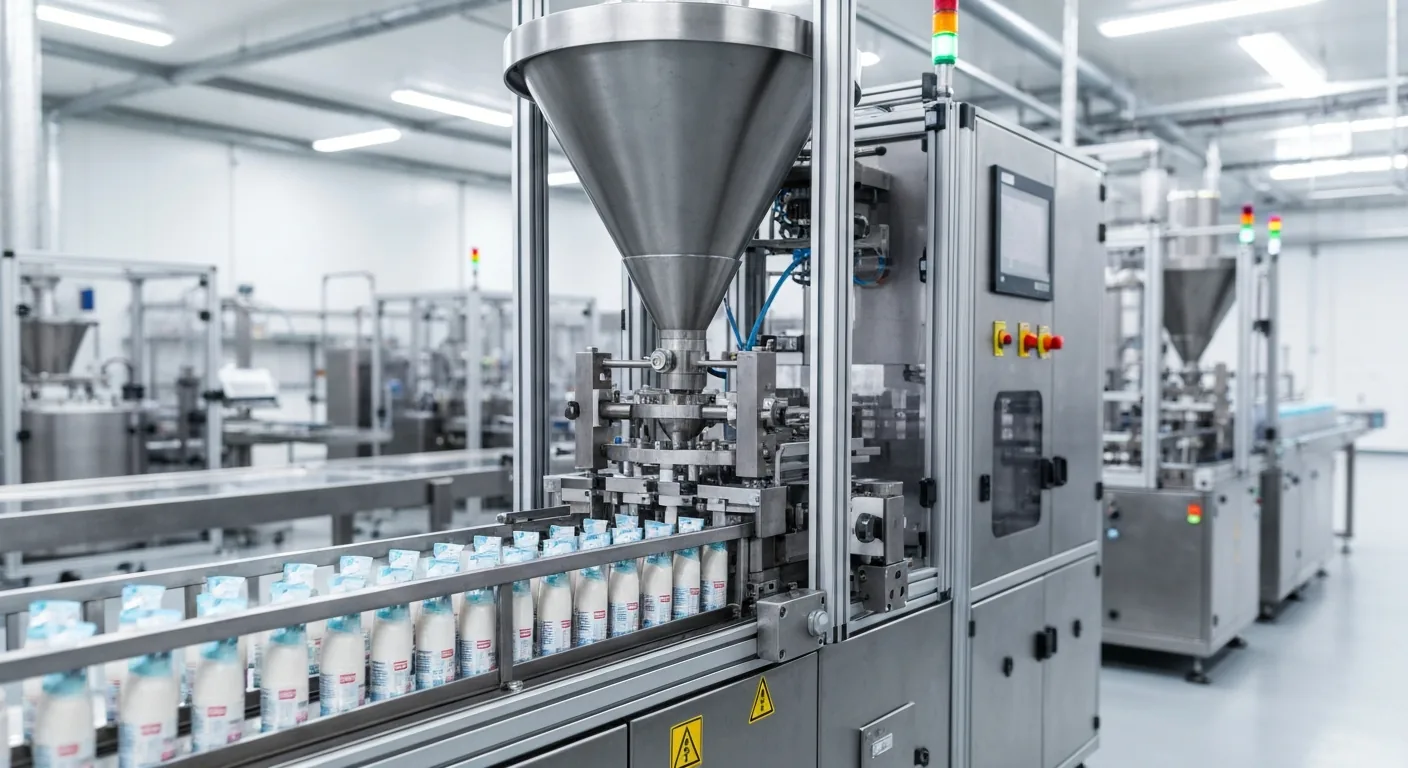
Form-Fill-Seal (FFS) is a packaging technology where the machine forms the container from roll stock film, fills it with product and seals it — all in a single continuous automated process. It is the dominant technology for liquid and semi-solid food products worldwide.
The Three Stages of FFS
- Form: Bottom film is heated and drawn into mould cavities by vacuum forming
- Fill: Product is dosed into the formed cavities — pneumatic or servo-controlled filling for accurate portions
- Seal: Top film is heat-sealed over the filled cavities and cut to final pack dimensions
FFS vs Pre-made Containers
| Factor | Pre-made Cups/Trays | FFS Roll Film |
|---|---|---|
| Packaging material cost | High | 30–50% lower |
| Storage space | Large (bulky containers) | Minimal (compact rolls) |
| Flexibility | Fixed sizes | Adjustable with mould change |
| Minimum order | High MOQ | Lower MOQ on film rolls |
Ideal Products for FFS Technology
- Sauces: ketchup, mayonnaise, mustard, hot sauce
- Spreads: honey, jam, marmalade, hazelnut paste
- Dairy: yogurt, cream cheese, labneh, butter portions
- Beverages: water, juice, dairy drinks
Pipak FFS Models
Pipak Makina offers three FFS models: MINI PACK (6,000 pcs/hr), π-66 MIDI PACK (12,000/hr with servo drive) and the flagship π-99 ELİT with 700-900 mm foil width for multi-lane industrial production.
Frequently Asked Questions
Can one FFS machine handle multiple products?
Yes. With a mould change kit, the same machine can produce different cup sizes and shapes. Changeover time is typically 20-40 minutes.
What film materials are used in FFS?
PA/PE, PP and PET-based multilayer films are standard. For barrier properties, EVOH-containing films are used. All must be food-grade certified.