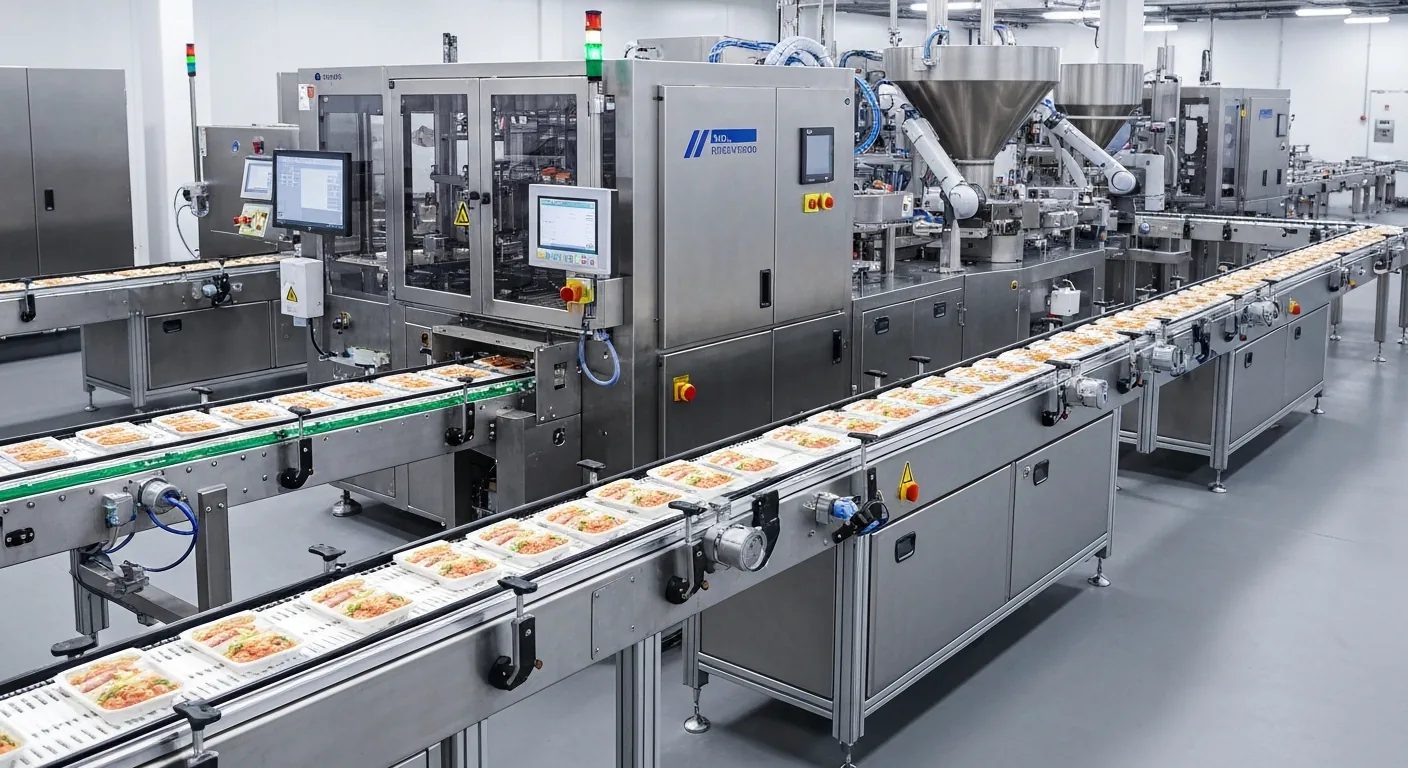
The ready meal sector is one of the fastest-growing segments in food manufacturing. Convenience-driven consumer demand — accelerated by urbanization, smaller household sizes, and foodservice expansion — has pushed ready meal producers to scale up operations while simultaneously tightening food safety and shelf life requirements. Packaging automation sits at the heart of this challenge.
This guide compares the two dominant automated packaging formats for ready meals — Form-Fill-Seal (FFS) and thermoform tray sealing — and provides a practical framework for selecting the right machine based on your production volume, product mix, and hygiene requirements.
What Counts as a Ready Meal for Packaging Purposes?
Ready meals span a broad spectrum: chilled pasta dishes, frozen meal trays, soup portions, stuffed pastries, rice-based dishes, meat-and-sauce combinations, and plant-based meal kits. From a packaging perspective, the key distinctions are:
- Product state: Chilled (2–5°C), frozen (-18°C), or ambient shelf-stable
- Product geometry: Pourable/liquid components vs solid portions vs mixed (e.g., rice + chicken + sauce)
- Heating method: Microwave, conventional oven, boil-in-bag, or steam — each imposes different film and tray requirements
- Portion size: Single-serve (250–400g), dual-serve (500–700g), or family pack (800g+)
These factors determine whether thermoform or FFS is the better fit — and which specific machine configuration within each technology delivers optimal results.
Thermoform Packaging vs FFS: Core Comparison
| Criterion | Thermoform (Tray Seal) | FFS (Pouch/Flow Pack) |
|---|---|---|
| Product geometry | Solid, semi-solid, mixed | Uniform, pourable, liquid |
| Presentation | Rigid tray — premium retail appearance | Flexible pouch — lower cost |
| MAP capability | Yes — gas flush + seal | Yes — gas flush + seal |
| Microwave compatibility | Yes (PP tray, steam-valve lid) | Limited (requires specific films) |
| Throughput (packs/hr) | 800–4,000+ | 1,500–8,000+ |
| Format changeover | Tooling change: 20–45 min | Film roll swap: 10–15 min |
| Investment level | Medium–High | Low–Medium |
For premium chilled ready meals targeting supermarket retail, thermoform tray sealing is the standard. The rigid tray provides structural integrity during transport, allows controlled steam-venting via peel-valve lidding for microwave use, and supports high-quality print presentation. FFS is better suited to cost-sensitive ambient or frozen portions where pack appearance is secondary to output speed.
Hygiene Standards for Ready Meal Packaging Lines
Ready meals are a high-care product category under BRC, IFS, and FSSC 22000 standards. The packaging area is typically a controlled zone with positive air pressure, temperature management (12–15°C ambient), and strict personnel hygiene protocols. Machine requirements in this environment include:
- Stainless steel AISI 304 on all product-contact and splash-zone surfaces
- Enclosed electrical cabinets with IP65 minimum rating
- No hollow tubular frames that can harbor microbial growth
- Accessible CIP points — mold, forming box, sealing platen must be fully disassembled and cleaned between product changeovers
- Documented and validated cleaning procedures (COP — Clean Out of Place is standard for mold components)
Pipak's π-33 MAX and MEGA MAX machines are built to food industry hygiene specifications with full stainless construction, removable forming molds (no tools required), and flat panel HMI displays with IP65-rated touchscreens that can be wiped down during washdown procedures.
Capacity Planning: How to Size Your Machine
The starting point is your target pack output per shift. Work backwards from your daily production requirement:
- Determine daily packs required (e.g., 15,000 packs/day in two 8-hour shifts)
- Divide by available machine hours (accounting for 85% OEE): 15,000 ÷ (16h × 0.85) = ~1,100 packs/hour
- Match to machine cycle rate and forming cavities: a π-33 MAX at 10 cycles/min with a 2-up tool = 1,200 packs/hour — sufficient headroom
- Validate against your product mix: if you run 6 different SKUs per shift, factor in changeover time (30 min per tooling change)
For operations with high SKU diversity and frequent changeovers, Pipak's quick-change tooling system reduces mold swap time to under 20 minutes, which materially improves overall line efficiency on multi-product runs.
Film and Tray Specifications for Ready Meals
Ready meal packaging must address both the cooking/reheating method and the distribution environment. Key specifications:
- Microwave PP trays: Crystallized PP (CPET or PP) rated to 200°C oven or microwave. Tray wall thickness 350–450 µm for structural integrity when hot-filled.
- Steam-release lid films: PETG or PET/PE composites with a laser-scored vent line that opens at a defined internal pressure (typically 0.3–0.5 bar overpressure during microwave heating).
- Chilled MAP trays: APET/PE bottom web with EVOH/PE lid film. OTR <5 cm³/m²/day. Standard MAP blend: CO₂/N₂ 30/70 for protein components.
- Frozen meal trays: CPET — withstands both -40°C freezing and 220°C oven temperatures. Lid film must maintain seal integrity across this temperature range.
Frequently Asked Questions
Can one thermoform machine handle both chilled and frozen ready meal formats?
Yes, provided the machine supports the relevant film types and sealing parameters for each. CPET trays for frozen meals require higher forming temperatures (160–180°C) than standard APET chilled trays (100–120°C). Pipak machines with servo-controlled heating zones can be programmed with saved product recipes that switch all parameters automatically when changing between formats.
What throughput can a Pipak π-66 MIDI PACK achieve for ready meals?
The π-66 MIDI PACK running a 2-up forming tool at 8–10 cycles per minute delivers approximately 960–1,200 packs per hour for standard 220×160mm ready meal trays. With a 4-up tool on smaller portion sizes, output increases to 1,920–2,400 packs per hour.
Is MAP packaging necessary for all ready meals, or is vacuum sufficient?
For multi-component meals (e.g., rice + meat + sauce), MAP is strongly preferred over vacuum. The cushioned gas atmosphere prevents sauce migration and compression of the product during transport, which vacuum would cause. For single-component solid products (e.g., stuffed pastry), vacuum can be viable but MAP typically delivers a better consumer experience at point of sale.
How does a thermoform machine handle liquid sauce components in ready meals?
An inline liquid dosing station — a peristaltic pump or piston filler mounted between the filling zone and sealing station — dispenses controlled volumes of sauce into each tray. Dosing accuracy is typically ±2–3g per portion. Pipak machines can be specified with integrated dosing units for sauced or soupy ready meal formats.