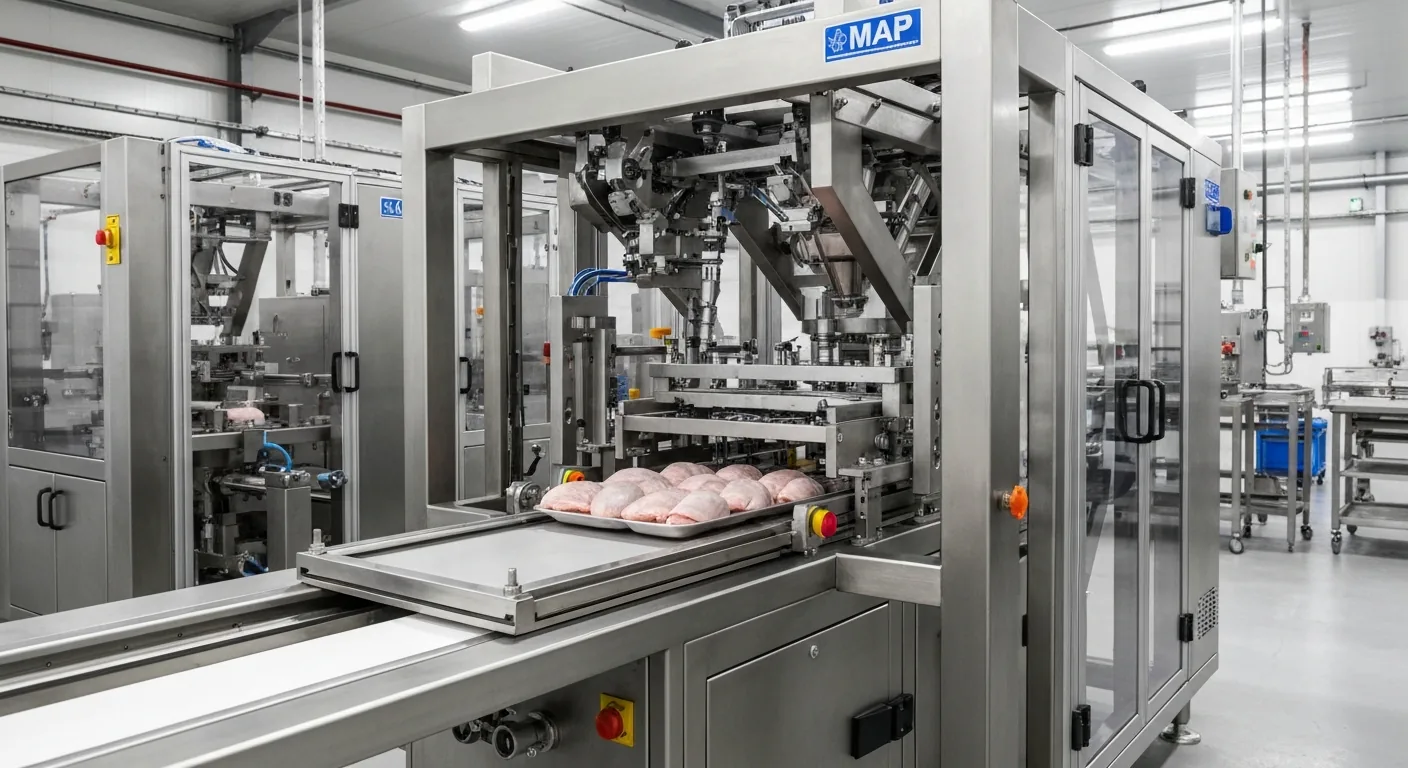
Poultry is one of the most perishable protein categories in the food industry. Chicken, turkey, and other poultry products are highly susceptible to bacterial growth — particularly Salmonella, Campylobacter, and Listeria — making packaging decisions critical for both food safety and commercial shelf life. Modified Atmosphere Packaging (MAP) has become the industry standard for extending poultry freshness without compromising product quality or consumer safety.
This guide covers everything poultry processors need to know: optimal gas mixtures, film specifications, machine selection, and the hygiene standards that apply at each stage.
Why MAP Packaging Is Essential for Poultry
Conventional air packaging gives fresh chicken a retail shelf life of just 2–3 days under refrigeration. With MAP, that window extends to 8–12 days, depending on the gas mixture and packaging integrity. This is a decisive advantage for processors supplying supermarket chains, export markets, or central kitchen operations.
MAP works by replacing the air inside the sealed package with a precisely controlled gas blend. This slows microbial activity and oxidation without the need for preservatives — a key selling point in clean-label product lines. For high-demand categories like boneless breast fillets, marinated drumsticks, or ready-to-cook portions, MAP consistently outperforms vacuum packaging in terms of color retention and consumer appeal.
Optimal Gas Mixtures for Poultry Products
The correct gas ratio depends on the specific product, cut, and target shelf life. Below are the industry-standard formulations used for common poultry categories:
| Product Type | CO₂ | O₂ | N₂ | Shelf Life (at 2–4°C) |
|---|---|---|---|---|
| Whole chicken / parts (fresh) | 30% | — | 70% | 10–12 days |
| Boneless breast / fillet | 30–40% | — | 60–70% | 8–10 days |
| Marinated poultry | 25–30% | — | 70–75% | 7–9 days |
| Minced / ground poultry | 20–30% | — | 70–80% | 6–8 days |
| Cooked / smoked poultry | 20% | — | 80% | 14–21 days |
Note that oxygen is typically excluded from poultry MAP. Unlike red meat, where O₂ is used to maintain oxymyoglobin's bright red color, poultry does not benefit from O₂ in the same way — and its presence would accelerate lipid oxidation and microbial spoilage. High-CO₂ / high-N₂ blends are the norm.
Film and Tray Selection for Poultry MAP
The packaging film must provide sufficient gas barrier performance to maintain the modified atmosphere throughout the product's shelf life. For poultry MAP, the following specifications apply:
- Bottom web (tray): APET/PE or PP-based rigid film, 250–400 µm thickness, OTR (oxygen transmission rate) <5 cm³/m²/day at 23°C
- Top web (lid film): PA/PE or EVOH/PE multilayer film, 60–90 µm, high gas barrier, good seal integrity at 140–160°C sealing temperature
- Antifog coating: Essential for retail packs — prevents condensation on the lid film, maintaining product visibility
- Peel-open feature: Preferred for consumer convenience; easy-peel lidding films with 3–8 N/cm peel force
Tray depth typically ranges from 30 to 60 mm depending on the cut. Boneless fillets can use shallower trays (30–40 mm), while whole legs or bone-in portions require 50–60 mm depth. Film format width on Pipak machines accommodates standard roll widths from 200 mm up to 660 mm, covering all common poultry tray sizes.
Hygiene Requirements in Poultry Packaging Lines
Poultry processing environments are classified as high-risk zones under HACCP plans, which places stringent demands on packaging equipment. Any thermoform machine operating in a poultry facility must meet the following criteria:
- IP65 or higher ingress protection on all electrical components — wash-down environments are standard
- Stainless steel AISI 304 or 316 construction on all product-contact surfaces
- No horizontal flat surfaces that could collect standing water or debris
- CIP (Clean-In-Place) compatibility for mold and sealing station components
- Positive air pressure cabinets where available, to prevent airborne contamination
Pipak's PPM π-33 MIDI and π-33 MAX machines are designed with food-grade stainless steel frames and tool-free disassembly for the sealing and forming stations, making CIP procedures fast and audit-compliant. For higher-volume operations, the MEGA MAX series supports automated gas flushing with servo-controlled dosing valves, ensuring gas mixture accuracy to within ±0.5%.
Choosing the Right Pipak Machine for Poultry Operations
Selecting the correct machine model depends on your daily throughput, tray format range, and whether you need inline gas analysis or manual QC checks.
| Machine Model | Forming Width | Cycles/min | Recommended For |
|---|---|---|---|
| π-11 MINI MAX | 200–320 mm | 4–6 | Small processors, 1–2 SKUs |
| PPM π-33 MIDI | 320–460 mm | 6–10 | Mid-size facilities, retail packs |
| π-33 MAX | 460–530 mm | 8–12 | Large supermarket supply chains |
| MEGA MAX | 530–660 mm | 10–15 | Export operations, multi-lane |
All models support MAP gas flushing as standard. The MEGA MAX additionally supports dual gas inlets for simultaneous flushing with different gas blends across multiple lanes — useful for mixed poultry product lines running on a single machine.
Cold Chain Integration and Label Requirements
MAP packaging does not replace cold chain management — it complements it. Poultry packed under MAP must be stored and transported at 0–4°C to achieve stated shelf life targets. Any temperature abuse above 7°C significantly accelerates CO₂ absorption into the product (reducing pack pressure) and creates conditions for pathogen growth, even within a sealed MAP pack.
Label requirements for MAP poultry in most markets include: use-by date, storage temperature, pack date, gas atmosphere declaration (e.g., "Packed in a protective atmosphere"), and country of origin. Export markets — particularly EU, GCC, and UK — may require additional allergen and traceability markings. Integrating a date coder or inkjet printer into the packaging line immediately downstream of the sealing station eliminates manual labeling errors.
Frequently Asked Questions
Can MAP packaging be used for frozen poultry?
MAP is primarily designed for chilled (0–4°C) fresh poultry. For frozen products, standard vacuum or barrier film packaging is more appropriate, as gas exchange rates change dramatically at freezing temperatures and the benefits of MAP are largely negated.
Why does MAP poultry sometimes develop pack collapse?
CO₂ is highly soluble in moist protein tissue. Over the first 24–48 hours, the product absorbs some CO₂, causing a slight reduction in pack volume. This is normal and does not indicate a seal failure. Increasing the N₂ ratio (to 70–75%) helps maintain pack rigidity throughout shelf life.
What is the minimum seal width required for poultry MAP packs?
A minimum seal width of 5 mm is recommended for MAP poultry packs to ensure gas-tight integrity. Pipak machines deliver a consistent 6–8 mm seal width as standard, with optional 10 mm tooling available for export market requirements.
Is MAP packaging compatible with halal-certified poultry operations?
Yes. The gases used (CO₂, N₂) are inert and carry no halal compliance concerns. However, the packaging films must be free from animal-derived additives, and this should be confirmed with your film supplier. Halal certification bodies typically require documentation on film composition as part of their audit process.