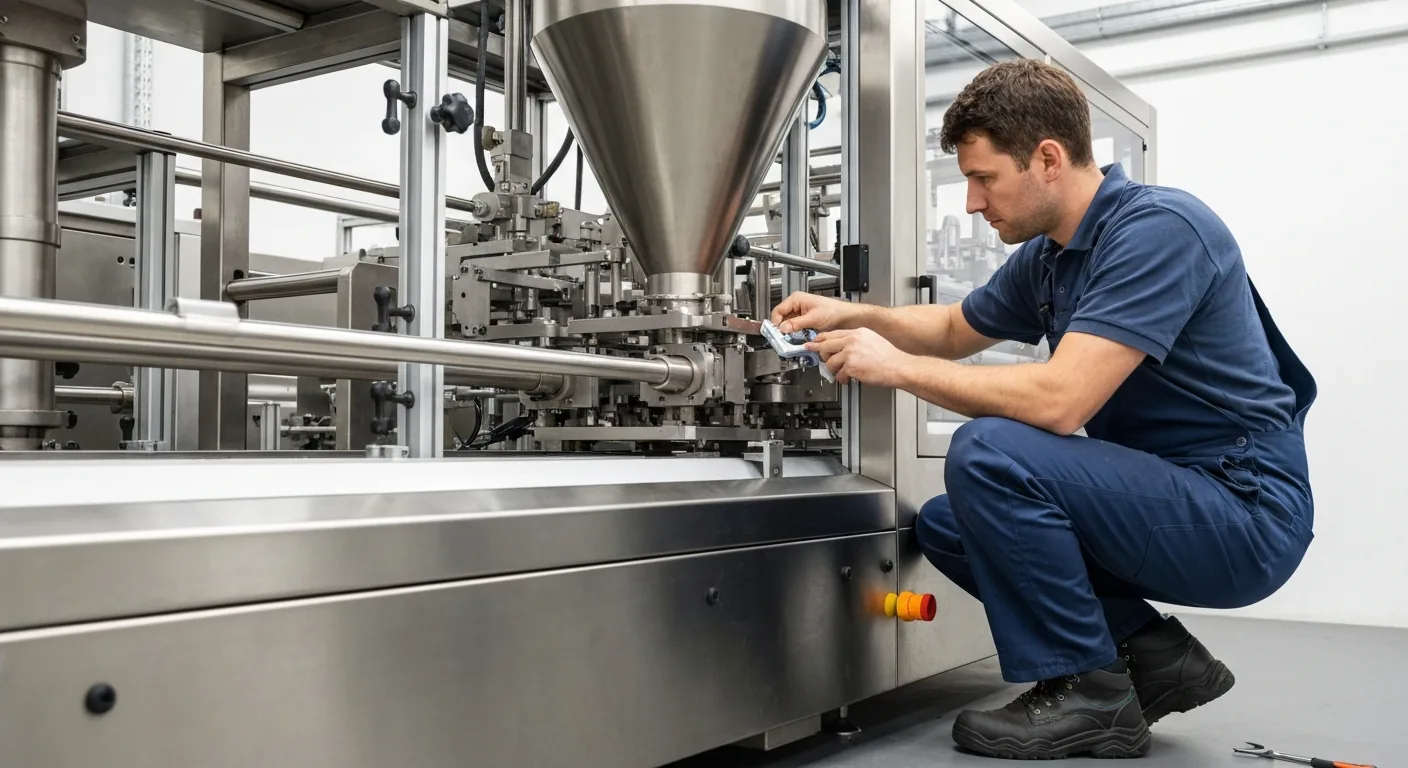
A thermoform packaging machine is a significant capital investment — and like any precision manufacturing equipment, its longevity and reliability depend almost entirely on how consistently it is maintained. Unplanned downtime on a packaging line during a production run costs far more than any scheduled maintenance task. Industry data consistently shows that facilities running structured preventive maintenance programmes achieve 30–50% lower maintenance costs and 15–25% longer equipment service life compared to reactive-only maintenance approaches.
The following 10 tips are organized by maintenance frequency — daily, weekly, and monthly — and are applicable to all Pipak thermoform machines including the π-11 MINI MAX, PPM π-33 MIDI, π-33 MAX, MEGA MAX, MINI PACK, π-66 MIDI PACK, and π-99 ELİT models.
Daily Maintenance Checks (Every Production Shift)
Inspect and Clean the Sealing Platen and Seal Frame
The sealing station operates at 140–180°C continuously throughout production. Food residue, film fragments, and condensate that accumulate on the sealing surface cause uneven heat distribution, resulting in weak seals or burn marks on the lid film. At the end of every shift — after the machine has cooled to below 60°C — wipe the sealing platen with a dry lint-free cloth, then inspect the seal frame for embedded film particles. Use a non-abrasive brass brush to remove stubborn residue. Never use steel wool or abrasive pads on Teflon-coated sealing surfaces.
Check Film Tracking and Tension on Both Web Rolls
Misaligned film tracking causes off-centre seals, film creasing, and waste. At the start of each shift and again after any film roll change, verify that both the bottom web (forming film) and top web (lid film) are running centrally through their respective guides. Check that the dancer arm tension on both unwind stations is within the set range (typically indicated by a mark on the tension dial). Incorrect tension — either too high or too low — leads to forming defects and inconsistent sealing. On Pipak machines, the web guide sensors alert the operator if tracking deviation exceeds ±3 mm.
Verify Compressed Air Pressure and Filter Condition
Thermoform machines use compressed air for forming (typically 4–8 bar), pneumatic clamps, and cutting systems. At shift start, confirm that the main air supply pressure is within the machine's specified operating range (usually 6 bar ±0.5 bar). Drain the water separator bowl in the air filter/regulator unit — water accumulation in the air line causes corrosion in pneumatic cylinders and inconsistent forming pressure. Replace the coalescing filter element every 2,000–3,000 operating hours or when the pressure drop across the filter exceeds 0.5 bar.
Log and Review the HMI Alarm History
Modern Pipak machines with PLC-based HMI controls log every machine alarm with a timestamp. Reviewing the previous shift's alarm log takes less than two minutes but provides early warning of developing issues: repeated temperature deviation alarms on a heating zone may indicate a failing heater element; repeated film-break alarms may indicate tension setting drift or a worn film guide roller. Catching these patterns early means a planned repair during a scheduled stop rather than an emergency breakdown mid-shift.
Weekly Maintenance Checks
Lubricate Forming Chain, Guide Rails, and Linear Bearings
The film transport chain (or index drive belt on belt-transport models) and the linear guide rails on the forming station traverse are the highest-wear moving components on a thermoform machine. Weekly lubrication with food-grade NSF H1 chain oil or grease (as specified in the Pipak maintenance manual for each model) prevents premature chain stretch and bearing wear. Over-lubrication is as damaging as under-lubrication — apply the specified quantity only. Wipe away excess to prevent contamination of the film or product.
Inspect the Cutting Unit: Knives, Die-Cut Plate, and Cross-Cut Blade
The cutting station — whether a cross-cut blade, punch-cut die, or rotary knife — is subjected to high impact forces at every cycle. Inspect the cutting edge visually each week for chipping, dulling, or misalignment. A dull knife requires increased cutting force, which accelerates wear on the knife mount, drive mechanism, and film web. On Pipak machines, the knife alignment is set with a feeler gauge to a clearance of 0.05–0.10 mm against the counter-plate. Realign if visual inspection suggests deviation. Replace knives according to the cycle-count schedule in the maintenance log — typically every 8–12 million cycles for standard stainless knives.
Test Gas Mixture Accuracy with a Portable Headspace Analyser
For MAP-equipped machines, weekly headspace analysis of production packs is non-negotiable. Pull three packs from different positions across the forming width and measure residual O₂ and CO₂ with a portable headspace analyser (e.g., a Mocon or CheckPoint unit). Acceptable O₂ tolerance is typically ±0.5% of the set point. Drift beyond this tolerance indicates: a gas supply pressure issue, a flow controller fault, a worn gas inlet valve, or a seal integrity problem allowing post-seal gas exchange. Identifying this weekly prevents an entire production batch from falling outside shelf-life specification.
Clean and Inspect All Heat Zones and Thermocouple Connections
The forming heater plate and sealing heater are controlled by thermocouples that feed real-time temperature data to the PLC. Loose or oxidised thermocouple connections cause inaccurate temperature readings, leading to under- or over-forming of trays. Weekly, shut down the relevant heater zone, allow it to cool, and check that all thermocouple connector terminals are tight and corrosion-free. Clean the heater surface with a dry cloth to remove any film or product buildup that could create thermal insulation hot spots.
Monthly Maintenance Checks
Perform a Full Seal Integrity Audit
Once per month, conduct a formal seal integrity audit using a combination of methods: visual inspection of seal width and uniformity (minimum 5 mm seal width across the full pack perimeter), bubble test (submerging sealed packs in water under slight compression and checking for bubbles), and peel-force testing with a tensile tester (target peel force depends on film specification — typically 8–15 N/25 mm for standard PA/PE combinations). Document results against your acceptance criteria and trend them month-on-month. A gradual decline in average peel force usually indicates sealing platen surface wear or calibration drift — both correctable with a planned service visit.
Schedule a Pipak Preventive Maintenance Service Visit
No internal maintenance programme fully replaces a factory-trained service visit. Pipak's service engineers carry out tasks that require specialist tools and calibration equipment: servo drive alignment checks, PLC battery replacement, pneumatic cylinder end-of-stroke buffer adjustment, electrical panel thermal imaging for loose connections, and mold dimensional verification (checking that forming depth and tray cavity dimensions remain within ±0.3 mm of original specification after extended use). For high-intensity operations running two or three shifts per day, a six-monthly service interval is recommended. Single-shift operations typically schedule annual service visits.
Maintenance Log and Documentation
All maintenance activities — daily checks, consumable replacements, alarm events, and service visits — should be recorded in a machine maintenance log. For BRC-certified facilities, this log is an auditable document. Pipak provides a pre-formatted maintenance log template for each machine model as part of the commissioning package. Digital maintenance log software (integrated with the machine HMI on π-99 ELİT models) allows automatic logging of alarm events and maintenance reminders based on cycle count or calendar time.
| Frequency | Task | Time Required |
|---|---|---|
| Daily | Seal platen clean | 5 min |
| Daily | Film tracking check | 3 min |
| Daily | Air pressure / filter drain | 2 min |
| Daily | HMI alarm log review | 2 min |
| Weekly | Chain / rail lubrication | 15 min |
| Weekly | Knife inspection | 10 min |
| Weekly | MAP headspace analysis | 20 min |
| Weekly | Thermocouple connection check | 15 min |
| Monthly | Seal integrity audit | 45 min |
| 6-monthly / Annual | Pipak service visit | 4–8 hours |
Frequently Asked Questions
How long should a thermoform packaging machine last with proper maintenance?
A well-maintained thermoform machine from a reputable manufacturer should provide 15–20 years of reliable service under single-shift operation. Two and three-shift operations can expect 8–12 years before major component rebuild is required. The forming mold tooling typically has a shorter service life of 5–8 years depending on cycle count and material.
What is the most common cause of unplanned downtime on thermoform machines?
In our experience, the three most frequent causes of unplanned downtime are: (1) sealing element or heater failure due to accumulated residue and thermal cycling fatigue, (2) film break caused by tension drift or guide roller wear, and (3) pneumatic cylinder failure from moisture contamination in the air supply. All three are preventable with the daily and weekly checks described above.
Can operators perform all maintenance tasks themselves, or is technical training required?
Daily and weekly tasks (cleaning, lubrication, visual inspection, air filter drain) can be performed by trained production operators after a half-day training session. Monthly seal integrity audits and any tasks involving the electrical cabinet, heater elements, or servo drives should only be performed by a qualified maintenance technician. Pipak offers operator training as part of machine commissioning.